an impulsive thought that deleted windows
2026-03-11
the aerial segmentation rabbit hole
I was deep into a university deep learning project: aerial image segmentation using U-Net, trained on a chunk of the ISPRS Potsdam dataset sourced from Kaggle. About 2,000 training patches at 300×300 pixels each, labeled into six classes: roads, buildings, low vegetation, trees, cars, and clutter. Classic computer vision stuff.
After about 2 epochs on my M1 MacBook Air, the math was doing something I didn't appreciate: 32 minutes for 2 epochs. A quick back-of-napkin calculation later, I was staring at a training timeline that was, diplomatically speaking, not feasible.
Then I remembered something. I own a Zephyrus G14 gaming laptop, AMD GPU, sitting right next to my desk. Windows on it, used exclusively for gaming and absolutely nothing else. Zero data to lose, zero hesitation.
U-Net loves GPUs. So naturally, an idea formed.
ROCm on AMD, it's complicated
Down the rabbit hole of running PyTorch on an AMD GPU: it requires ROCm instead of CUDA, which is already a bit niche, but fine. Still on Windows, I'm downloading things through PowerShell like I knew what I was doing... only to find that ROCm support on my specific model on Windows is essentially nonexistent.
However, on Linux there's a workaround documented in a GitHub issue that's been keeping AMD GPU users sane for a while: ROCm/ROCm#1756
That was the moment Windows' fate was sealed.
the impulsive part
I reached for my USB stick without a second thought. The Windows install had literally just a browser and Steam with some games. Bootable drive, metal boot, done.
Now what flavor of Linux? I've been a chronic distrohopper before getting my Mac. Ubuntu, Fedora, Arch, PopOS, I've seen things. I wanted something opinionated this time. So I went with Omarchy.
The install was almost suspiciously fast. Everything was just... there. Working. Out of the box. I genuinely couldn't believe how well-equipped this setup was from the start. Didn't expect that at all.
training on GPU, the payoff
Cloned the repo. Downloaded dependencies. Followed the ROCm issue. Set up the environment. Ran training.
7-8x faster than the M1 Mac CPU. That's it. That's the whole sentence. Going from "this is going to take geologically long" to "okay this is actually happening" was deeply satisfying in a way that's hard to overstate.
tinkering while training
While the model was doing its thing, I wasn't just sitting there watching loss curves. I was poking around the new environment.
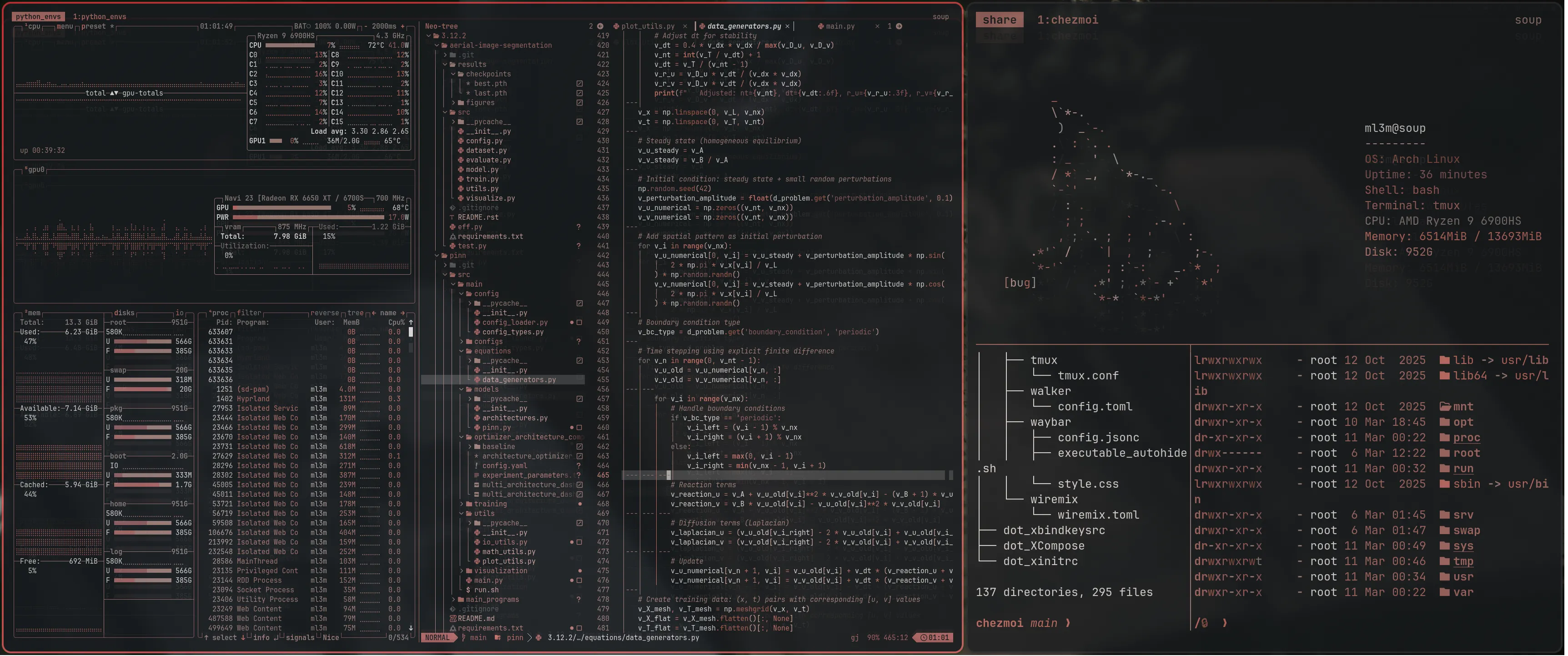
Neovim: the file tree isn't my personal preference, but fast and smooth and I genuinely can't complain. Coming from Packer on macOS, Lazy was a real upgrade. The update/install menu is slick, especially if you're familiar with Mason for LSPs, same energy, cleaner experience.
Alacritty: terminal. Well done. Nothing to add. Before Ghostty dethroned it as my daily driver, it was already my battle-tested main.
Hyprland: this one made me actually rethink how I work. Before the Mac (where I use Rectangle + Raycast keybinds for window management), I had been running i3 in an Arch VM on Windows 11. Hyprland on Wayland hits different. The tiling workflow is genuinely good and the animations don't feel like an overhead.
making the G14 a proper Linux machine
Three days after training finished, I hadn't really touched the project. I was just... tinkering. Making the gaming laptop actually do its job on Linux.
First stop: asus-linux.org. Turns out ASUS actually supports Linux for their ROG lineup. There's a custom kernel (linux-g14), fan control, LED control, and graphics switching all maintained by a community that clearly cares. Surprisingly solid support for a gaming laptop manufacturer.
The key pieces: asusctl for fan profiles and LED control, power-profiles-daemon for power management, and the linux-g14 custom kernel. The whole setup process is well-documented and it just works. The uname -r output with -g14 in it hits different.
gaming on Linux, no, seriously
Steam installed. Games launched. And then I sat there wondering why I ever thought gaming required Windows.
Tested: Baldur's Gate 3, Cult of the Lamb, Death Stranding, Hogwarts Legacy, and in several of these, framerates were measurably higher on Linux than they had been on Windows. Not a placebo. Real numbers on the same hardware.
Credit where it's due: Valve's Proton is a genuine engineering achievement. And the ProtonDB community is invaluable, anytime something was acting weird, someone had already documented the exact launch options to fix it. The community really carries this.
I'm not going back. I was already doing everything productive on my Mac. Now gaming is covered away from Windows too. Goodbye, Microslop.
the dotfiles, naturally
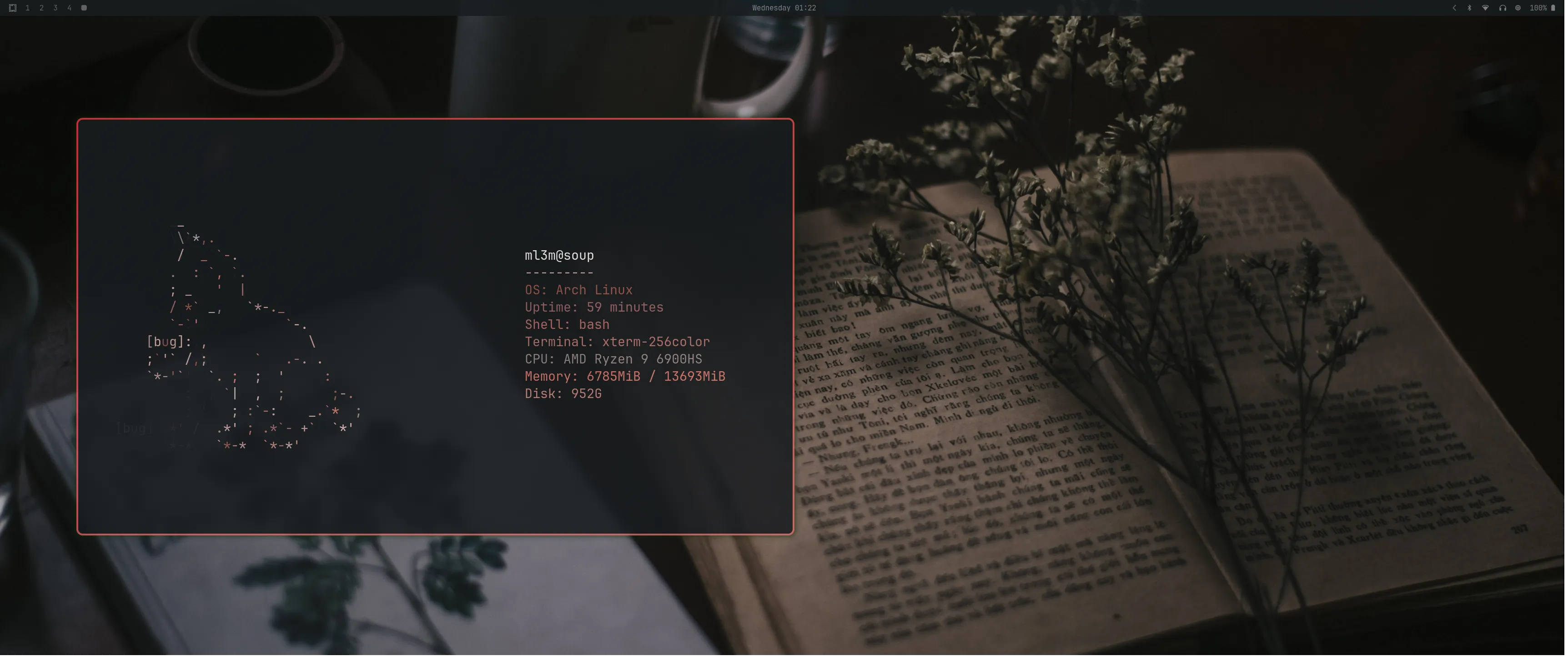
At some point during all this tinkering I integrated my macOS dotfiles into the new setup. The theme is warm and cozy, amber tones, soft glows, calm background. Lean into it.
I'm using Chezmoi to manage them. Cool project, handles machine-specific templating cleanly and makes syncing across installs not annoying at all.
The repo: ml3m/dot
mlem